
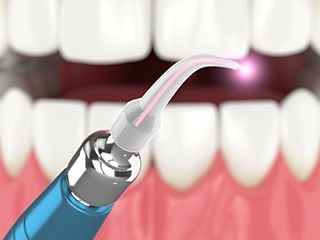
 Lasers direct a controlled force of energy that can remove or alter bone and tissue. By applying varying wavelengths of energy, dental lasers are used to detect and treat a myriad of oral health issues, including detecting oral cancer and treating small cavities.
There are two different types of dental lasers: hard tissue lasers and soft tissue lasers.
With unparalleled precision, hard tissue lasers emit a wavelength that can cut through bone, or more specifically, the calcium phosphate that make up our bones and teeth. The hard tissue laser eliminates the need for a dental drill, which is often associated with uncomfortable noise and vibrations.
Hard tissue lasers are typically used for:
- Removing decay to a tooth for a filling
- Detecting cavities under the gum line
- Treating tooth sensitivity
Soft tissue lasers emit a wavelength that is easily absorbed by water and hemoglobin, a molecule found in the blood. Soft tissue lasers cut through soft tissue and seal exposed blood vessels at the same time, which is why laser treatments often have little bleeding and heal quickly.
Soft tissue lasers are typically used for:
- Reshaping gums to lengthen crowns, or for cosmetic purposes, like treating a “gummy” smile
- Making changes to soft tissue, like treating limited tongue movement or removing soft tissue that causes sleep apnea
- Detecting abnormal tissue, like oral cancers
- Treating infection in the root canal or gums
Lasers sterilize what they touch and seal any blood vessels they cut, which means dental lasers:
- Reduce the need for sutures
- Reduce the need for anesthesia
- Reduce risk of infection
- Reduce healing time significantly
- Reduce blood loss during treatments